- About us
- Navigator of support measures
- Success stories
-
Useful information
- Implementation of the Competition Development Standard in the constituent entities of the Russian Federation
- Report "The state and development of competition in the constituent entities of the Russian Federation"
- Disclosure of information by subjects of natural monopolies
- Legislation and official documents
- Development territories
- Contact Navigator
- Investor's personal account


-
To the investor
- General information about the Omsk region
- "One window" for the investor
- Surveys
- Commercial services
- The region's strategy
- Investment proposals
- Investment proposals of municipal districts of the Omsk region
- Investment declaration of the Omsk region
- Industrial clusters of the Omsk region
- Support measures
- Investment Activity Council
- A plan for the creation of investment facilities and facilities for the necessary transport, energy, social and other infrastructure
- Code of investment rules of the Omsk region
- Investment attractiveness
- Proactive budgeting
- Action plan to improve the investment climate
- Advantages of the region
- Investment platforms
- Investment projects
- Public-private partnership
- ASI Experts
General information about the Omsk region
GENERAL CHARACTERISTICS OF THE REGION |
|
|
Omsk region is located in the center A vast continent in the south The West Siberian plain. |
The territory of the Omsk region 141.1 thousand km2 |
The territory of the region is 141.1 thousand square kilometers (0.8% of the territory of the Russian Federation), of which 47.6% is agricultural land, 33.1% is forests, 16.4% is water bodies, including swamps, 2.9% is other lands. The territory of the Omsk region includes 6 cities, 32 districts, 21 work settlements, and 1,477 rural settlements. Omsk region stretches from north to south for more than 600 km, from west to east for 300 km. The Omsk Region borders the Tyumen Region in the west and north, the Tomsk and Novosibirsk regions in the east, and the Republic of Kazakhstan in the south. The distance from Omsk to Moscow is 2555 km. Omsk Irtysh region is located in the fifth time zone, the time difference with Moscow is 3 hours.
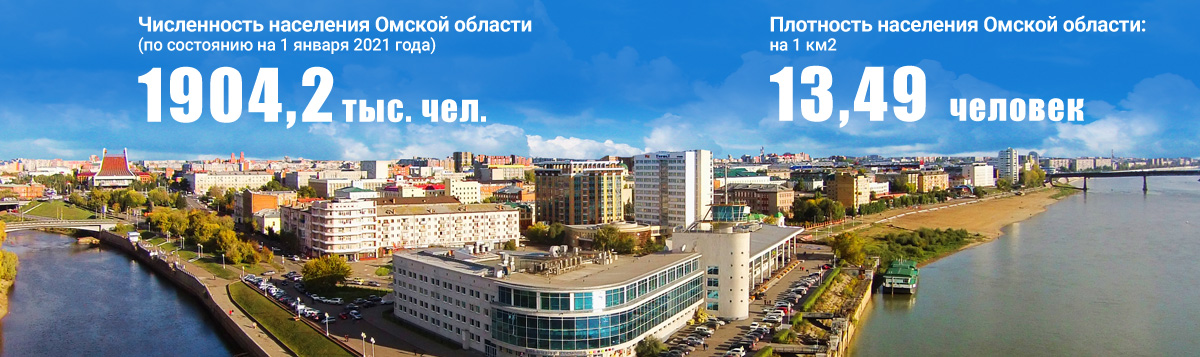
Omsk region has a well-developed network of transport communications. The Trans-Siberian Railway runs along the 55th parallel of northern latitude through the region, connecting the western and eastern regions of the country. Highways connecting the northern territories of Russia with the regions of the Republic of Kazakhstan and the countries of Central Asia also pass through the region.
The transport network of the Omsk region consists of: |
|
|
751 km railway tracks |
|
|
1,474 km inland waterways |
25.04 thousand km length of highways |
The distance from Omsk to Moscow is 2,555 km.
1831.8 thousand people live in the Omsk region (Omsk, 32 districts) (as of January 1, 2023).
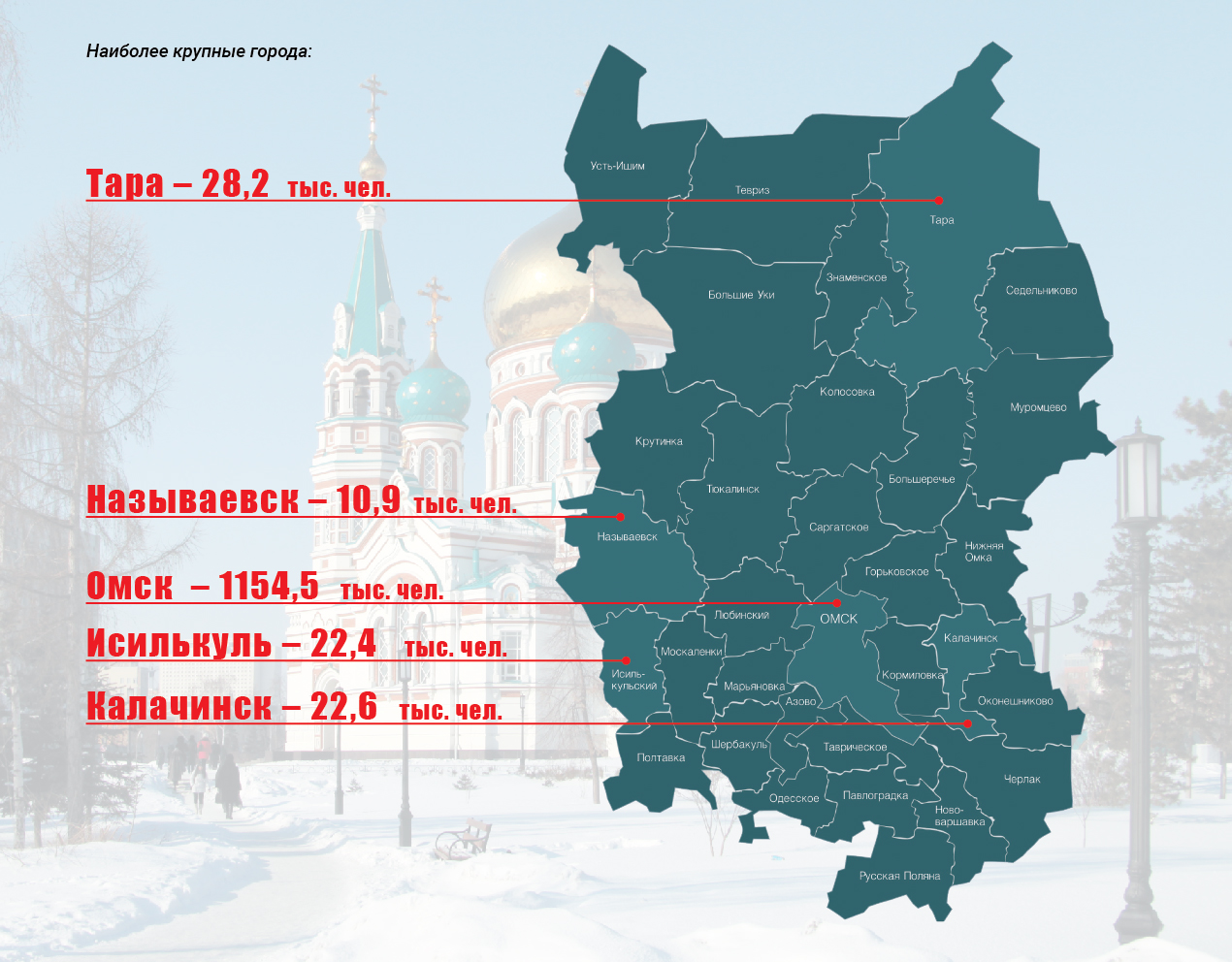 The Omsk region is characterized by a high concentration of the population in a city of one million people, which opens up wide opportunities for the development of the consumer market and reduces the cost of maintaining infrastructure.
The ratio of urban and rural residents is 74.3% and 25.7%, respectively. The average population density of the Omsk region is 12.98 people per 1 square km.
The national composition of the population of the Omsk Irtysh region is represented by more than 122 nationalities and 12 ethnic groups.
The region has reserves of:
- oil,
- gas,
- peat,
- zirconium and titanium ore sands,
- marsh marl,
- sapropel,
- mineral mixtures,
- medicinal mud.
The main natural resources of the Omsk region are soil resources, which make it possible to develop large-scale grain farming and all types of animal husbandry. The region is located in several natural complexes: full taiga, small-leaved forests, northern and southern forest-steppes and steppes. Birch and aspen predominate in the hardwood forest area, while pine, fir, spruce, and cedar predominate in coniferous forests. There are more than 4 thousand rivers and 16 thousand lakes in the region.
Large lakes of the Omsk region:
- Saltaim (146 sq. km),
- Shade (118 sq. km),
- Ebates (96 sq. km),
- Ir (71 sq. km).
More than ten water bodies in the region have the status of natural monuments, among them Lakes Uljai and Ebeyty, relict salt lakes with halophytes and large deposits of therapeutic sulfide mud.
The climate of the Omsk region is continental, the average temperature in January is 14.9 C, in July +18 C.
